
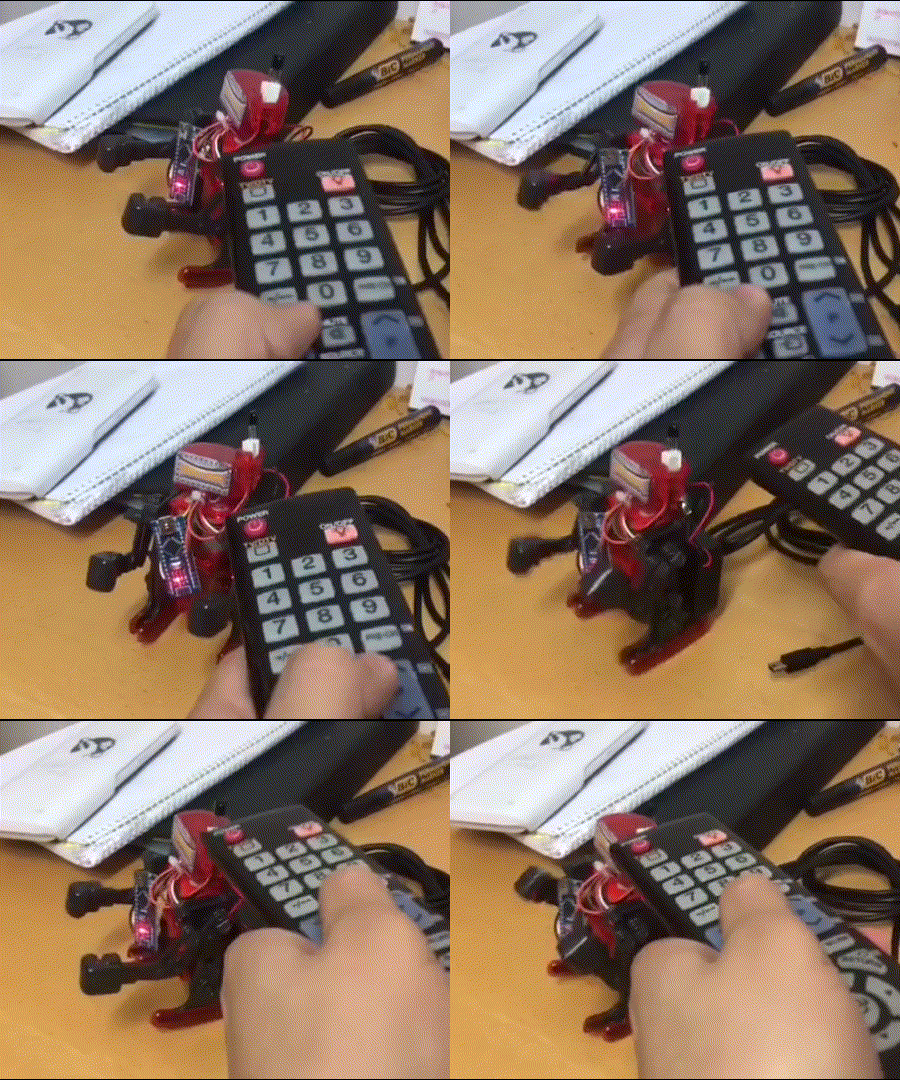
My little brother had a little robot toy that was controlled with a wired remote which I was really annoyed by. What’s the point of a tethered walking toy? When he was gonna throw it out, I wanted to modify it to be remote control and thought it’d be interesting to use a TV remote.
Beep Boop
TV remotes1 use infrared (IR) light to communicate. The remote has an LED that flashes IR light on and off in a binary sequence (an IR code) that can be detected by an IR sensor and translated in the TV. My robot needed an IR sensor2 to detect the IR codes from a TV remote.
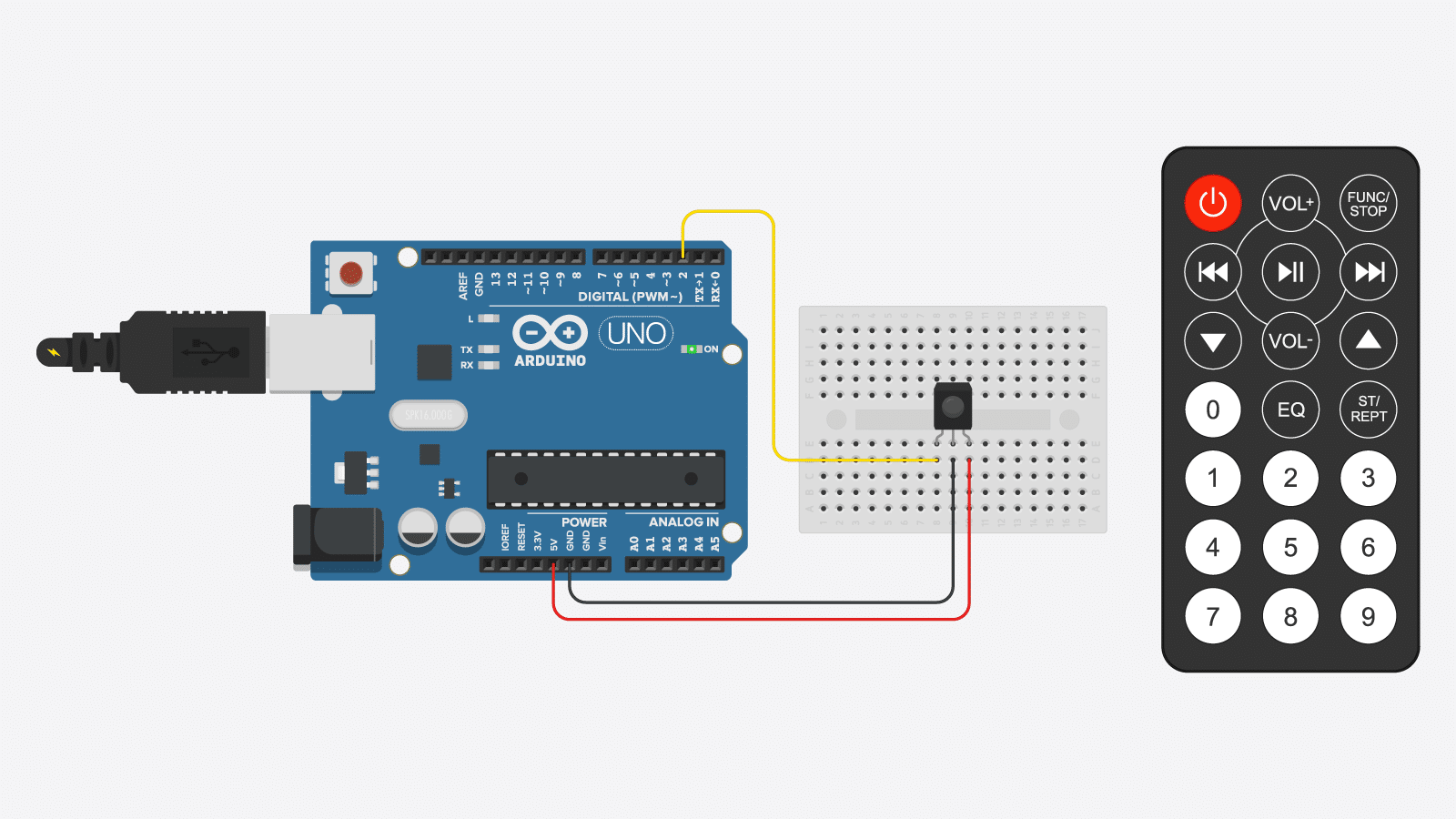
I chose to use an Arduino Nano because that was the only microcontroller I had at the time. A microcontroller is required to process the IR codes from the TV remote and control the motors. This Makerguides tutorial shows how to use the IRremote library to receive and interpret IR codes. First, I wrote a loop which printed incoming IR codes to serial and figured out which codes were for the “channel up” and “volume up” buttons on my TV remote. Then I wrote some if statements in void loop() to respond to those button presses.
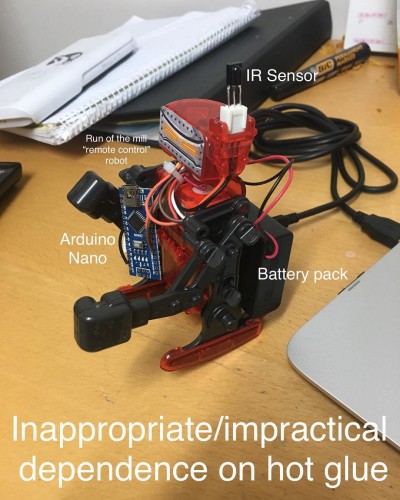
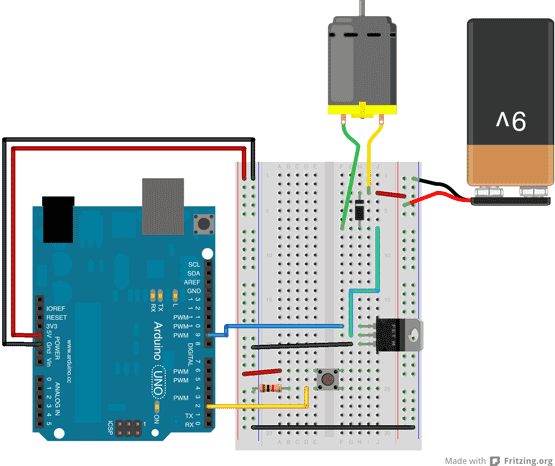
Although I didn’t label them in the image (below), but there are 2 transistors in the head to provide more current to the motors than the Arduino can provide itself. If you try to power a motor directly through the Arduino‘s GPIO pin, it will spin very weakly and possibly fry the Arduino. Transistors can be used like switches the allow weak signal from the Arduino to control the flow of electricity from the battery to the motors. Below is a diagram from the Arduino Docs tutorial on Transistor Motor Control. I omitted the diode for back EMF in my circuit (it’s only a component safety precaution) and didn’t implement a physical push button either.
For power, I used a 3xAA battery pack. Each AA battery gives about 1.5V, all 3 total to 4.5V (battery packs wire all the batteries in series, sum the voltages which is close enough to the 5V required by the Arduino, and plenty for the robot motors.
I no longer have the code for the project, but it was incredibly simple. You should be able to write your own using the tutorials linked.
- Some newer smart TV remotes are beginning to use Bluetooth or Wifi instead of IR, but most TVs still use IR at time of writing (2025) ↩︎
- or I could’ve used an LED instead ↩︎
Leave a Reply